family business succession
Children Not Interested in the Family Business? What to Do
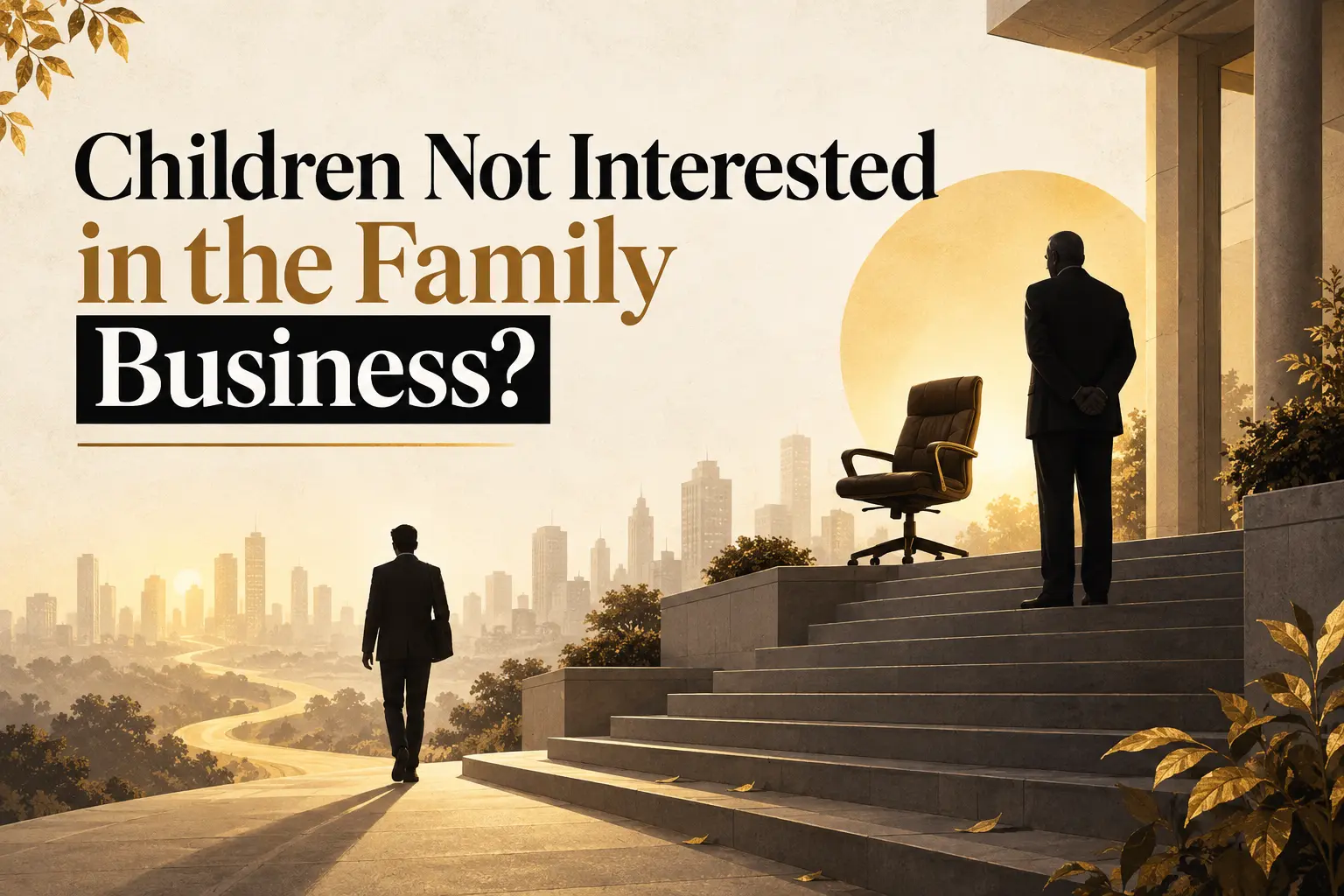
"Papa, I don't want to join the business."
Many founders hear these words one day. And it hurts.
You worked hard for 30 years. You always believed your son or daughter would take over one day. Now they want a different life.
If your children are not interested in the family business, you are not alone. In 2025, HSBC Global Private Banking found that 79% of Indian business owners want to pass the business to family. But only 7% of the next generation feel they must take it over.
So this is very common. And it is not the end of the story.
A "no" today does not always mean "no" forever. What you say and do next can bring your child closer to the business, or push them further away.
In this blog, you will learn why children say no, what they really mean, and six simple steps you can take.
You are not the only founder hearing this
Read those two numbers again. 79% of owners are planning for family. Only 7% of the next generation feel bound to say yes.
Most founders are planning around a promise their children never made.
In many Indian families, taking over the business was never discussed. It was simply expected. The child grew up hearing about it at weddings, at festivals, from uncles and staff.
This does not mean today's children do not care. It means duty is no longer enough of a reason. The next generation wants to choose, not be chosen.
Why children say no to the family business
The reason a son or daughter gives is usually short and polite. "I want my own career." "I'm not interested in manufacturing." "Maybe later."
The real reasons sit underneath. Here are the most common ones.
They want to prove themselves on their own
In the family business, every success gets credited to the father's name. Staff, customers and bankers see "the owner's son", not a capable person.
Many children want one place where their work is judged on its own. Outside the business is often the only place they can find that.
They have seen what it cost you
Children grow up watching. They saw the late nights, the missed holidays, the tension over cash, the phone calls at dinner.
You see a business you built. They may see a life that kept their father away from home. Their "no" is sometimes a no to that life, not to the business.
They see a title, but no real role
Some children have already tried. They joined for a year or two. Every decision still went back to the founder. Their ideas were "noted".
They did not leave because they were lazy. They left because there was no space to lead. Sandeep has written about this pattern in They're not ready yet.
Nobody ever asked them properly
This is more common than founders admit.
The expectation was set when the child was ten. "One day this will all be yours." It was said with love. But it was never a question. So the child never felt free to answer honestly, until now.
They fear working under you
Loving your father and reporting to him are two very different things. Many children know they will clash with you at work. They choose distance to protect the relationship.
That is not rejection. In a way, it is care. If those clashes are already happening in your family, read How to disagree in a family business without hurting the family.
Is it "no", or "not like this"?
Before you plan anything, find out what kind of no you heard. There are usually three.
| What they said | What it often means | What helps |
|---|---|---|
| Not now | I want experience and confidence first | Let them work outside. Keep the door open. |
| Not like this | I want in, but not on your terms | Talk about role, authority and timeline |
| Not ever | I have a different path | Accept it and plan beyond the family |
Many founders hear "not now" as "not ever". Then they either give up too early or push too hard. Both close the door.
A clear, calm conversation is the only way to know which one you are facing.

What to do when your children are not interested
There is no single right answer. But these steps help most families.
1. Have the real conversation
Not a lecture. Not a pitch about how good the business is.
Ask, and then listen. What do you want your life to look like in ten years? What would make the business attractive to you? What would make it impossible?
Let the silence sit. The first answer is rarely the full one.
2. Give them the freedom to say no
This sounds strange. But a child can only give a true yes if a no was allowed.
Tell them clearly: "You don't owe me this. I will be fine either way." Then show them it is true in how you treat them afterwards.
A child who joins out of guilt will struggle. A child who joins by choice will fight for the business.
3. Let them work outside first
Some of the strongest successors spent years somewhere else. They learned how other companies run. They built confidence that has nothing to do with the family name.
If they come back, they come back with something to add. If they do not, you have lost nothing.
4. Offer a different kind of role
Your child does not have to become you.
A son may not want to run the factory but may want to build the export side. A daughter may not want daily operations but may want a seat on the board. One child may want to be an owner, not a manager.
Leading the business and owning it are two different things. Once you separate them, options appear that did not exist before.
5. Look beyond your children
If no child wants to run the business, it does not have to end with you.
Some families bring in a professional CEO. The family stays as owners and sits on the board. Tata is the well known example. The group separated ownership from management and built governance that did not depend on one person's judgment. The business outlasted its founder by design.
A trusted senior manager, a nephew or niece, or a son-in-law or daughter-in-law may also be worth a real conversation.
6. If nobody wants it, plan the sale early
Sometimes the right answer is to sell, to merge, or to bring in a partner.
This is not failure. What hurts a business is a sale done in a hurry, after a health scare or a family fight. A planned sale, done over years, protects the value you built and the people who work for you.
Talk to your CA and lawyer early. And talk to your family before you finalise anything.
| Option | When it fits | What to watch |
|---|---|---|
| Child joins later | "Not now" answer, outside experience first | Keep the door open without pressure |
| Child joins in a new role | "Not like this" answer | Give real authority, not only a title |
| Family owns, professional CEO runs | No child wants daily control | Clear board, clear rules, clear reporting |
| Sale or partner | Nobody in the family wants it | Start years early, not in a crisis |
When you are ready to plan the handover itself, the steps are in Succession in family business: how to hand over control step by step.

The hardest part is not the business
When a child says no, most founders go straight to one question. What happens to the company?
The harder question is quieter. What happens to me?
For many founders, the business and the self have grown into one. The commitment that built the company is the same thing that makes this news so hard to hear. That commitment was never the problem. The situation has changed.
Sandeep Amar Guppta has worked with business families for over 40 years. He often reminds founders that inheritance and succession are not the same thing. Inheritance passes on shares. Succession passes on stewardship, and stewardship does not have to be carried by your own child.
"Inheritance determines ownership. Succession determines the future."
A business that continues with a strong team, a clear board and your family's values is still your legacy. Perhaps even more so.
Questions to sit with
Before you decide what happens next, ask yourself:
- Did I ever ask my children, or did I only assume?
- Was their answer "not now", "not like this" or "not ever"?
- Would I respect their choice if it had nothing to do with the business?
- If my child never joins, what do I want this business to become?
- Am I disappointed for the business, or for myself?
The last question is usually the hardest. It is also the one that shows you where to start.
Frequently asked questions
What should I do if my son is not interested in the family business?
Start with an honest conversation, not a pitch. Find out if his answer is "not now", "not like this" or "not ever". Give him real freedom to say no. Many children return later, after working elsewhere, if the door is left open without pressure.
Why is the next generation not interested in family business?
Many want to prove themselves on their own. Some have seen what the business cost their parents. Others fear clashing at work, or once had a title with no real authority. For most young people, duty alone is no longer enough.
Can a family business survive without a family successor?
Yes. Many families keep ownership and hire a professional CEO to run daily operations. The family stays involved through the board. This works best when roles, rules and reporting are clear and agreed in advance.
Should I force my children to join the family business?
It rarely works. A child who joins under pressure often stays unhappy and may leave later. That hurts both the business and the relationship. A child who joins by choice brings far more energy and commitment.
When should I plan a sale if no child wants the business?
Years before you want to step back. A planned sale protects value, staff and customers. A rushed sale after a health or family crisis usually loses value and causes more conflict at home.
A different kind of legacy
Your children saying no to the business is not them saying no to you.
Often, it is the first honest thing they have said about their future. That is worth protecting.
The business can continue. The family can stay close. They do not have to be the same thing.
So, has your family had this conversation yet? Or is everyone still assuming?
If your family is facing this question, Sandeep works with business families on exactly these conversations. Learn more about his Family Business Succession advisory or talk to Sandeep.
About Sandeep Amar Guppta
Sandeep Amar Guppta has spent more than forty years in the rooms where families and businesses meet and often collide.
A Fellow Chartered Accountant by training, he learned early that the numbers were never the hardest part. What decided a family's future was rarely the balance sheet. It was the conversations they were brave enough to have, and the ones they kept avoiding.
Known as 'The Conscious Profitability Man,' Sandeep is an international keynote speaker, author, and creator of The S.H.E. Framework. He works with business families, corporates, and leaders on the questions most advisors leave untouched: intergenerational conflict, leadership transition, and the building of a legacy that outlasts its founder. His gift is to make the deep practical, the complex simple, and the spiritual profitable.
He has carried this message to Oxford University, the Science of Consciousness Conference, the ISUD World Congress, and corporate stages across continents. Alongside his chartered accountancy, he holds a postgraduate diploma in Philosophy and Religious Studies and certifications in interpersonal neurobiology and design thinking. He chairs the Professional Speakers Summit (PSS) for its 2027 edition.
Work with Sandeep: sandeepamarguppta.com/work-together