Family business advisory
Family Constitution for a Family Business in India

A family constitution is most useful before the family agrees it needs one.
A family constitution sets out how a family will make decisions about its business. It can clarify who may join, how leaders are chosen, how family members are paid, and how disagreements are handled. It does not replace a will, shareholders' agreement or legal advice. Its value comes from the conversations used to create it and from applying it when decisions become difficult. For Indian family businesses, the work should begin before a handover becomes urgent.The meeting that comes before the document
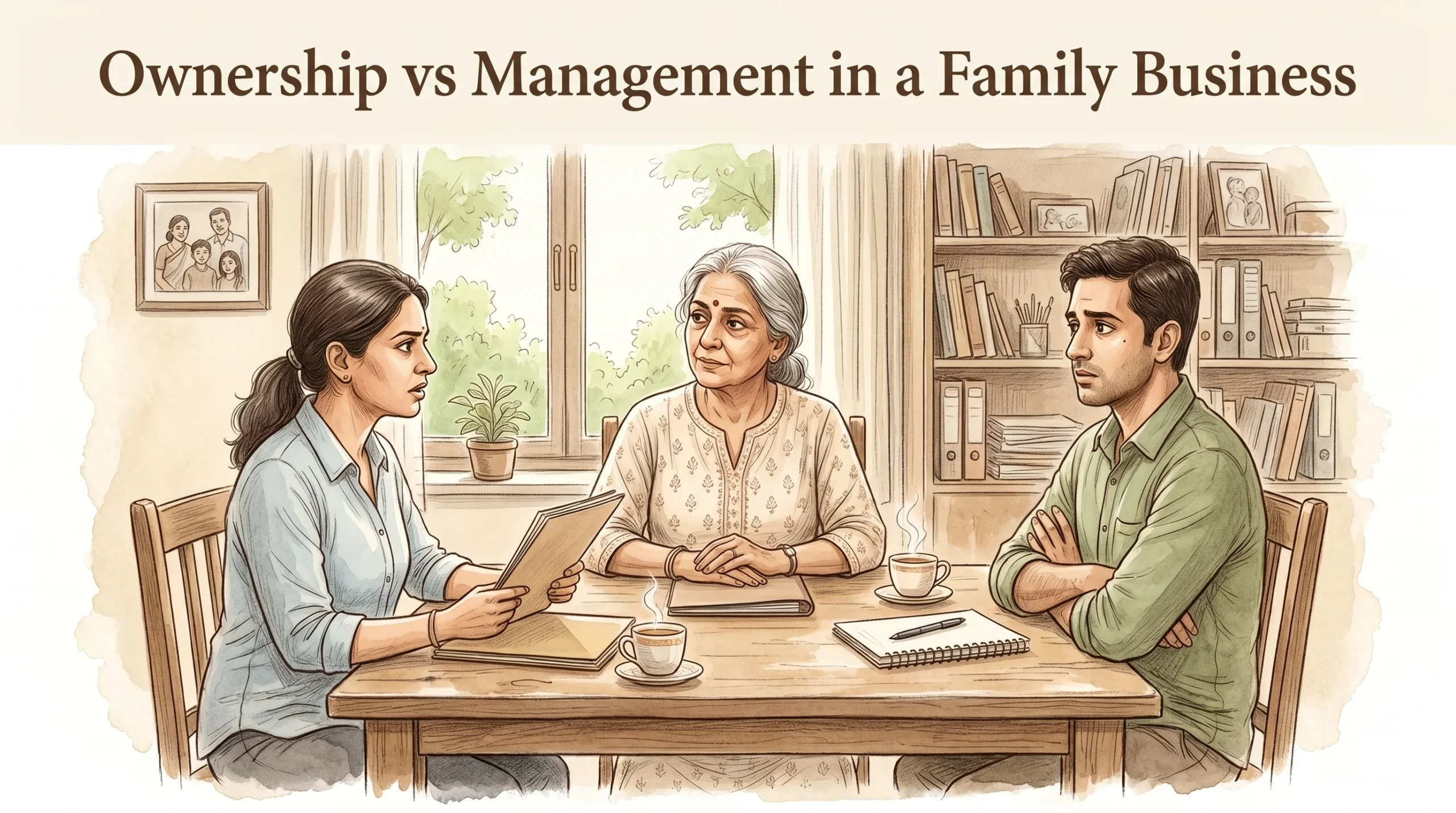
The founder has asked his lawyer to review the succession papers. His daughter manages operations. His son handles sales. Other family members own shares but do not work in the company. Everyone believes they understand how the business should run. Then a difficult question appears. Should another family member be allowed to join the company? Who decides how much that person earns? What happens when the founder and the next generation disagree about a major investment? Nobody has written down the answers. The family does not lack goodwill. It lacks shared rules. This is where a family constitution becomes useful. It gives the family a way to discuss these questions before they become personal disputes.A family constitution and a succession plan do different jobs
A family constitution records the principles and agreements that guide the family's relationship with its business. It explains how family members intend to work together, make decisions and handle disagreements. Succession planning deals with the transfer of leadership, ownership and responsibility. A constitution can support that process, but it cannot prepare a successor by itself. A will serves a different purpose. A shareholders' agreement addresses matters between shareholders. Company documents have their own legal role. These documents need to work together. A family constitution should be reviewed alongside the relevant legal and ownership documents by qualified advisers. A document can record an agreement. It cannot create genuine agreement by itself.
What should a family constitution include?
A useful constitution answers real questions. It does not need complicated language. It needs clear rules that family members understand and are willing to follow. 1. The purpose and values of the business Why does the family want to keep the business? What values should guide decisions when profit and personal preference point in different directions? The family should also discuss whether its main aim is to grow the company, protect its existing value, create opportunities for future generations or pursue a combination of these goals. Shared words are not enough. The family needs to agree what those words mean when money is at stake. 2. Roles, authority and decision-making Who runs daily operations? Which decisions belong to the board? Which matters require agreement among family owners? A family member may own shares without managing the business. Another may lead the company without owning the largest share. The constitution should recognise these different roles. It should also explain how major disagreements will be handled. A founder cannot remain the final decision-maker on every matter while expecting the next generation to take full responsibility. 3. Rules for family members joining the business Can every family member expect a job? Must applicants have qualifications or work experience outside the family company? The family should agree on entry requirements, reporting lines, performance reviews and promotion criteria. The same discussion should cover what happens when a family employee does not meet the required standard. These rules protect the business and the family member. They remove the need to make every appointment a personal decision. 4. Pay, profits and ownership Family members who work in the company may receive salaries. Family members who own shares may receive dividends when properly declared. These are different matters and should not be confused. The family should agree on the principles behind pay, profit distribution and reinvestment. It should also discuss how ownership questions will be considered when a family member wants to leave or transfer an interest. The legal and financial arrangements must be checked with the family's chartered accountant and lawyer. 5. Leadership and succession How will the next leader be chosen? What experience must that person gain before taking charge? When will authority move from the founder to the successor? A title change does not complete a handover. The next generation needs real responsibility, access to important relationships and the chance to make decisions. For a deeper look at this challenge, read Succession in family business: how to hand over control step by step. 6. Conflict resolution and regular review Disagreements will still happen. The constitution should explain how family members will raise concerns, hold difficult discussions and seek neutral help when they cannot reach an agreement. It should also state how the family will review its rules as the business and family change. A document written years ago may no longer fit the company. A regular review keeps the agreements relevant.
The cost of leaving the rules unwritten
Unwritten rules can appear to work while the founder remains involved in every decision. The problems often become visible when the business grows or another generation takes responsibility. Decisions become slow. Managers wait for the founder even when the next generation holds the relevant title. Good people lose trust in the system. Non-family employees may see family members receive different treatment. Capable managers begin to question whether performance matters. Money becomes personal. A disagreement about salary or dividends starts to feel like a judgement on one family member's contribution. The next generation receives responsibility without authority. They are expected to deliver results but cannot make the decisions needed to produce them. These problems are not always caused by bad intentions. The founder may be protecting what took decades to build. The successor may be trying to prove that the business can grow under different leadership. Both may be acting in good faith. The difficulty is that they are working with different expectations.What lasting family businesses can teach us
The Gucci family story offers a warning about authority without a shared way to make decisions when family members disagree. Inheriting control does not automatically provide the judgement or agreement needed to use it well. The Tata example offers a different lesson. Ownership, management, values and governance need not depend on one person's judgement alone. Neither example suggests that one document guarantees a successful business. A constitution cannot remove every conflict or replace capable leadership. The lesson is simpler. A family's rules and decision-making principles must be passed on deliberately, rather than left for the next generation to discover. This is closely connected to the idea that inheritance is not succession. Ownership can be transferred through formal arrangements. Trust, judgement and stewardship need to be developed over time.How to create a family constitution that people will use
The drafting should follow the discussion, not replace it. Start by listening. Speak with family members individually before bringing everyone into the same room. The founder, the successor and family members outside daily operations may have different concerns. Agree on the questions first. Identify the decisions that create uncertainty. Start with employment, authority, compensation, ownership and succession. Do not begin with a template. Test the rules against real situations. Ask what happens when the founder disagrees with a successor, a family employee underperforms or one owner wants to leave. General statements become useful only when the family agrees how to apply them. Check the legal and financial arrangements. Work with the family's lawyer and chartered accountant to align the constitution with relevant documents. Be clear about which provisions express family principles and which require separate legal agreements. Review what happens after the agreement. Set a date to review the rules. Check whether family members are following them and whether decision-making has become clearer. This is a process of assessment, alignment, preparation and action. It is not simply a writing exercise. For family businesses in Delhi and across India, the details will depend on the family's ownership structure, relationships and ambitions. Copying another family's document will not answer those questions.Questions to ask before you begin
Before drafting a family constitution, take time to answer these questions honestly.- Can your son or daughter disagree with you about a business decision without damaging the relationship at home?
- Does every family member know which decisions they can make independently?
- Are the rules for hiring and paying relatives clear to non-family employees?
- If you stepped away for three months, would the company know who could make its important decisions?
Another way to see it
“The technical work is mostly being done. The human work is mostly not.” A family constitution can record agreed rules. The family must still build the trust and capability needed to live by them. The document matters. The real test is what happens when someone disagrees.Frequently asked questions
What is a family constitution for a family business?
A family constitution is a written framework that records how a business-owning family agrees to work together. It can cover family employment, leadership, decision-making, values, ownership principles and conflict resolution. Its purpose is to make expectations clear before important decisions create tension. Each family should develop rules that fit its circumstances rather than copy another family's document.Is a family constitution the same as a shareholders' agreement?
No. A family constitution sets out the family's shared principles and its intended approach to business matters. A shareholders' agreement addresses legal and commercial arrangements between shareholders. A will serves another purpose. The documents may need to support one another, so the family should obtain legal advice on the wording, enforceability and alignment of its arrangements.When should an Indian family business create a constitution?
The family should consider one while relationships still allow open discussion. Useful moments include the next generation joining the company, the business expanding, ownership becoming more complex or the founder beginning to plan a leadership transition. There is no single date that suits every family. Starting before a crisis gives family members more time to discuss difficult questions and agree on practical rules.Does every family member need to agree to the constitution?
The family should work towards meaningful agreement, especially on rules that affect ownership, work and leadership. A signature alone does not show that someone accepts the principles or understands the consequences. Each person should have a chance to raise concerns and ask questions. Where disagreement remains, the family should address it openly rather than record a false sense of agreement.Can a family constitution prevent succession disputes?
It can reduce uncertainty by making expectations and decision-making rules clearer. It cannot guarantee that disputes will never arise. The result depends on how honestly the family creates the constitution, how it fits with the legal arrangements and whether family members follow it when decisions become difficult. Regular review and open communication remain necessary as the business and family change.About Sandeep Amar Guppta
Sandeep Amar Guppta has spent more than forty years in the rooms where families and businesses meet and often collide.
A Fellow Chartered Accountant by training, he learned early that the numbers were never the hardest part. What decided a family’s future was rarely the balance sheet. It was the conversations they were brave enough to have, and the ones they kept avoiding.
Known as ‘The Conscious Profitability Man,’ Sandeep is an international keynote speaker, author, and creator of The S.H.E. Framework. He works with business families, corporates, and leaders on the questions most advisors leave untouched: intergenerational conflict, leadership transition, and the building of a legacy that outlasts its founder. His gift is to make the deep practical, the complex simple, and the spiritual profitable.
He has carried this message to Oxford University, the Science of Consciousness Conference, the ISUD World Congress, and corporate stages across continents. Alongside his chartered accountancy, he holds a postgraduate diploma in Philosophy and Religious Studies and certifications in interpersonal neurobiology and design thinking. He chairs the Professional Speakers Summit (PSS) for its 2027 edition.
Work with Sandeep: sandeepamarguppta.com/work-together